


EIGHT CATEGORIES OF INTELLIGENCE
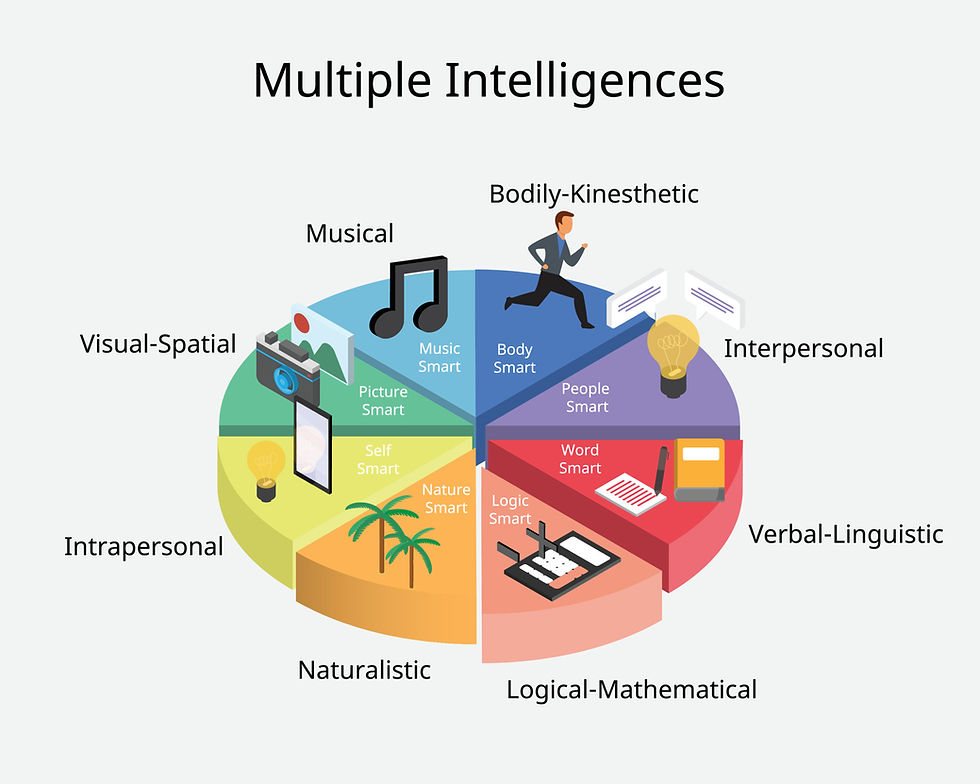
Smart career exploration involves more than reading about professional paths and interviewing people in an industry. It also involves self-reflection about your strengths and passions. A great way to begin this introspection is with Howard Gardner’s theory of multiple intelligences.
According to Gardner, intelligence should be broken down into eight categories:
visual-spatial
musical-rhythmic
verbal-linguistic
logical-mathematical
bodily-kinesthetic
interpersonal
intrapersonal
naturalistic
If you have a great deal of visual-spatial intelligence, then you’re probably good at remembering faces, doing puzzles, and folding origami. You may want to consider career paths such as graphic or interior design, architecture, photography, or mechanical engineering.
Another area of intelligence is musical-rhythmic. Have you been successful at learning an instrument? Do you effortlessly sing in tune and find the beat to your favourite songs? If so, you may dream of rock star fame, but there are other professions to consider as well including sound engineer, songwriter, or music teacher.
Verbal-linguistic intelligence involves the ability to use and learn languages. Does writing come easily to you? Do people love your stories? Do you enjoy poetry? If yes, then you likely possess above average visual-linguistic intelligence. In addition to a career as a book author, you may want to consider one as a publicist, lawyer, journalist, or librarian.
On the other hand, if you’re a math whiz, you love brain teasers, and geek out on statistics, you likely will score high on a standard I.Q. test. Howard labelled this “traditional” intelligence as logical-mathematical. Consider careers in computer science, medicine, and finance to name a few.
Athletes, dancers, carpenters, farmers, and surgeons usually have high-levels of bodily-kinesthetic intelligence. If you love physical activity, are well-coordinated, and can easily manipulate physical objects, consider these and other careers that allow you to get up and move or use your hands.
If you’re good at persuading and leading, then you are employing your keen interpersonal intelligence, also known as social intelligence. You’re probably curious about others, enjoy conversation, and are exceedingly empathetic. If you are one of these “people-smart” individuals, then your calling may be in sales, teaching, management, or politics.
Intrapersonal intelligence involves a deep understanding of your own thoughts, emotions, and aspirations. Do you already know which of Gardner’s intelligences are your strengths? If you know yourself well, then you have high levels of intrapersonal or emotional intelligence (EQ). You relate well to others and can excel in fields like psychology, social work, or career counseling.
Naturalistic intelligence relates to your ability to be “one with the planet.” Do you spend your free time hiking in the woods or exploring ponds? Do you revel in the changes in your local flora and fauna as the seasons cycle around you? If you find the physical world exhilarating, then perhaps a career as a geologist, marine biologist, conservationist, or veterinarian will be a good fit.
So, there you have it--a quick run-down of Gardner’s theory of multiple intelligences as well as some related career options. Remember though, you are a complex combination of all of them and identifying your strengths doesn’t mean you shouldn’t build upon the others.
Career success in any field is dependent on deploying multiple intelligences. In most jobs, you’ll need to use language effectively, apply logic and math skills, and leverage strong inter- and intrapersonal skills. Nonetheless, we tend to be most successful in areas that capitalize on our strengths.
Choosing a career that allows you to maximize your talents and invoke your passions—to do what you love— will keep you motivated and enthusiastic.
Motivation and enthusiasm, in turn, will drive your career success.”
(Shannon M. Lougee - Online Community Management Professional)


Comments